Posted By Admin on May 27, 2025
The Wonderful Contrast Between Old World and New World Red Wines
Stepping into the mysterious world of red wine, you may encounter the confusing concepts of "Old World" and "New World". How exactly are these two terms defined? Let’s explore the mysteries together.
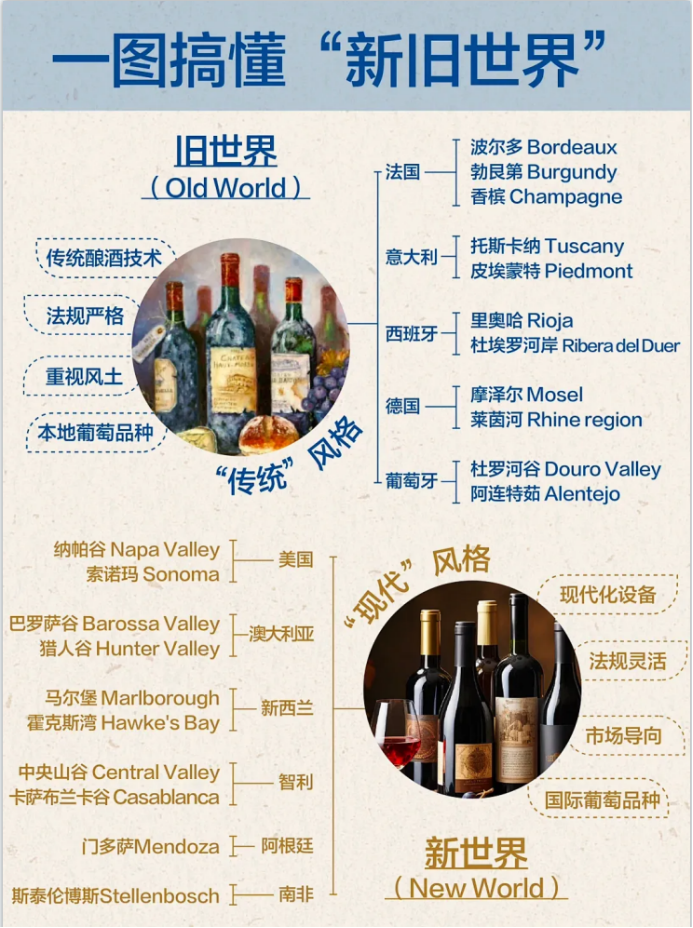
Core Countries of the Old World: France, Spain, Italy, Germany, Portugal, Hungary, etc. Core Countries of the New World: The United States, New Zealand, Australia, Chile, Argentina, China, etc.
Old World and New World red wines exhibit significant differences in many aspects. Let’s explore their disparities from multiple dimensions.
1. Historical Background and Brewing Traditions
Old World: Primarily located in Europe, including countries such as France, Italy, and Spain. These regions have diverse climate conditions but are generally mild, conducive to grape growth and red wine brewing.
Old World: Boasts a long winemaking history and traditions, with many wineries and regions having centuries of history. Old World red wine brewing techniques are often passed down through generations, emphasizing traditional craftsmanship and the spirit of craftsmanship.
New World: Relatively late to start large-scale commercial grape cultivation and red wine production, with a shorter history. However, New World red wines focus on innovation and technological applications in production, pursuing modern production processes.
1985|Achieving Overnight Fame Cloudy Bay's Sauvignon Blanc entered London, surprising the world with its tangy fruitiness that subverted traditional perceptions. Since then, New Zealand white wines have joined the lists of premium wines!
2. Geographical Location and Climate Conditions
Old World: Primarily located in Europe, including countries such as France, Italy, and Spain. These regions have diverse climate conditions but are generally mild, conducive to grape growth and red wine brewing.
New World: Covers non-European regions such as Australia, the United States, and Chile. These areas have varied climate conditions, often more extreme (e.g., hot or arid), which profoundly influence the taste and style of red wines.
3. Planting and Brewing Methods
Old World: Emphasizes terroir conditions and focuses on the ecological balance and natural laws of vineyards. There is less intervention in the planting process to showcase the characteristics of grapes and their origin. Traditional craftsmanship and manual brewing are also emphasized during production, pursuing complex layers and elegant structures in red wines.
New World: Places greater emphasis on technological applications, with more artificial intervention in grape planting and brewing. Modern tools such as advanced irrigation systems and temperature-controlled fermentation tanks may be used to improve red wine production and quality. Meanwhile, New World red wines also focus more on the direct expression of fruitiness and taste.
4. Regulations and Hierarchical Systems
Old World: Has strict wine regulations and hierarchical systems, such as France’s AOC (Appellation d'Origine Contrôlée) or Italy’s DOCG (Denominazione di Origine Controllata e Garantita). These systems detail regulations on grape planting, yield, brewing methods, etc., to ensure the quality and characteristics of red wines.
New World: Has relatively lenient regulations, giving winemakers more freedom to experiment and innovate. The hierarchical systems for New World red wines are less strict than those of the Old World, but corresponding quality standards and regulatory mechanisms still exist.
5. Taste and Style
Old World: Red wines have an elegant and delicate taste, focusing on structure and balance. They have higher acidity and tight tannin structures, making them more suitable for aging. The style tends to be subtle and balanced, reflecting the unique terroir characteristics of the region.
New World: Red wines typically have rich fruitiness, full-bodied tastes, and higher alcohol content, making them more approachable. The tannins are softer, offering good immediate drinkability.
6. Packaging and Wine Labels
Old World: Packaging is relatively traditional and elegant, focusing on marking the origin and style. Wine labels contain complex information, including regions, grades, etc., requiring a higher level of wine knowledge from consumers.
New World: Packaging is more diverse and modern. Wine labels have simple and intuitive information, often indicating grape varieties, vintages, and brief descriptions, making it easy for first-time consumers to make quick choices.